GLOBAL-CAPABILITY-02 · BESS COMMISSIONING
Commission the integrated system, not isolated equipment.
For overseas owners, EPC teams, OEMs and integrators coordinating work in Korea, completion needs a traceable path from the approved system configuration and safe test boundary to integrated scenarios, performance evidence and an accepted as-left package.
SYSTEM BOUNDARY
Six workstreams that must remain on one approved timeline
System identity and authority
Battery, rack, BMS, PCS, transformer, switchgear, protection, EMS, SCADA, auxiliaries, firmware, settings, drawings, permits and named approval roles.
Energy and emergency readiness
AC and DC isolation, stored energy, backfeed, automatic operation, restricted zones, PPE, rescue, fire response, ventilation and stop-work authority.
Equipment-level proof
Battery and BMS, PCS and DC link, HVAC or liquid cooling, gas and fire signals, auxiliary AC/DC/UPS, protection, communications and local controls.
Grid and control integration
PCC, transformer and breaker states, CT/VT and relay evidence, synchronization, active and reactive power commands, BMS/EMS/SCADA time and quality.
Functional and performance tests
Charge and discharge, limits, trips, loss of communication or auxiliary power, emergency stop, restart inhibition, staged recovery and rollback.
Accepted as-left operation
Final settings and source files, test originals, discrepancies, restrictions, alarms, training, spares, maintenance, emergency contacts and accountable follow-up.
EVIDENCE GATES
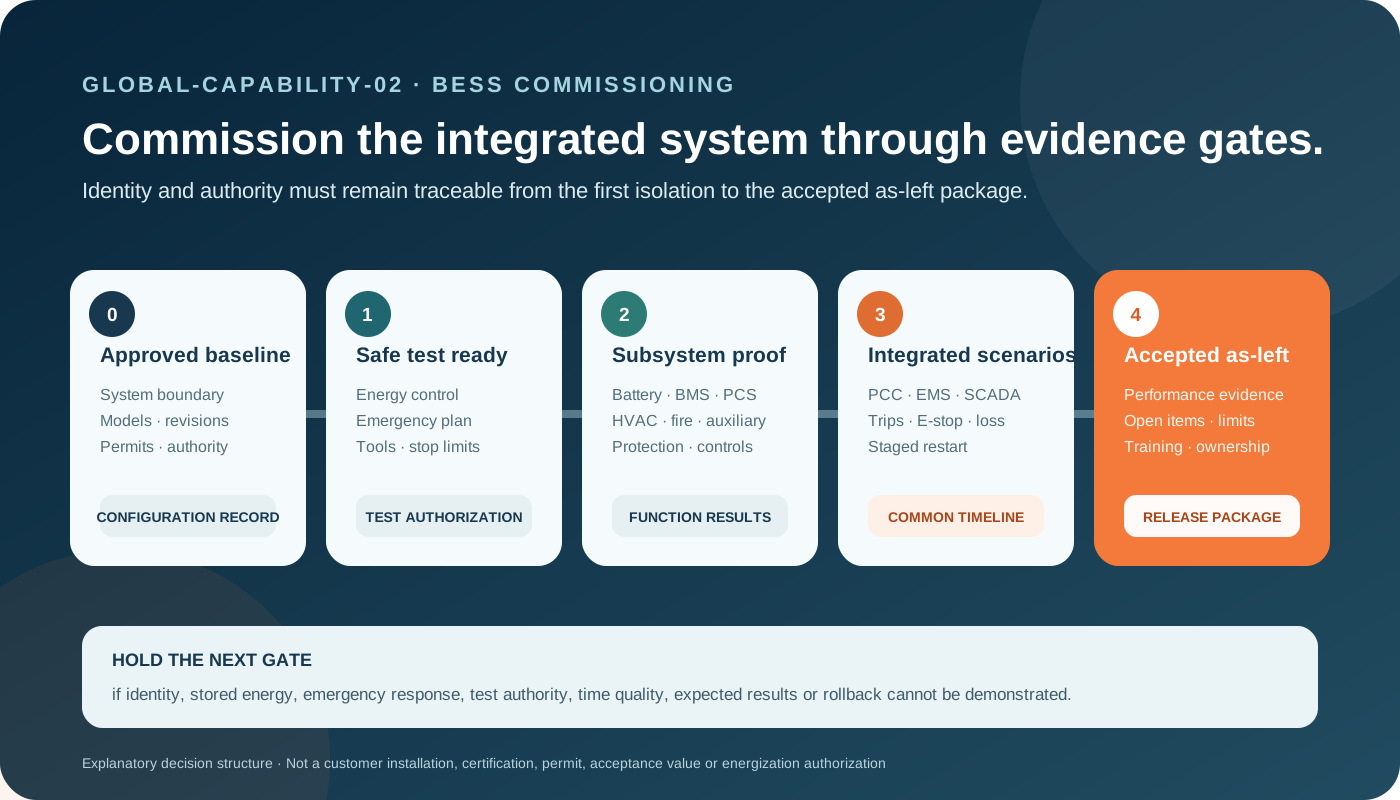
Release each gate only when its evidence supports the next one.
| Gate | Question to close | Minimum evidence | Named output |
|---|---|---|---|
| 0 · Approved baseline | What exact system and revision are being accepted, under whose authority? | Asset and model list, one-line and network drawings, firmware and settings, certificates and permits, acceptance plan and responsibility matrix | Approved configuration and discrepancy register |
| 1 · Safe test ready | Which energies, hazards, automatic functions and emergency interfaces are controlled for this test? | Isolation and test boundary, stored-energy verification, work permits, emergency plan, calibrated tools, expected result, stop and rollback limits | Signed test authorization and hold points |
| 2 · Subsystem proof | Can each subsystem demonstrate its approved inputs, logic, outputs and protective response? | As-found condition, point-to-point results, alarms, trips, interlocks, cooling, fire signals, auxiliary power, communication and local fallback | Subsystem function records and open-item list |
| 3 · Integrated scenarios | Does the complete BESS respond correctly across battery, PCS, grid, EMS, SCADA and emergency boundaries? | Common timestamps, command and readback, breaker and relay SOE, charge/discharge sequence, abnormal scenarios, staged restart and rollback evidence | Integrated functional test package |
| 4 · Accepted as-left | What proves performance, operability and accountable release? | Approved performance method and conditions, actual results, final settings and backups, residual restrictions, training, maintenance and acceptance signatures | Accepted as-left and handover package |
STOP CONDITIONS
Hold commissioning when the next decision cannot be supported safely.
Physical equipment, firmware, settings, drawings, certificates or the approved test plan do not match.
Stored energy, backfeed, automatic start, remote command or affected personnel cannot be controlled.
Fire response, gas or ventilation status, restricted zones, rescue plan or stop authority is unavailable.
BMS, PCS, relay, EMS and SCADA events cannot be aligned or the original evidence would be overwritten.
The approved criterion, operating condition, tolerances, responsible reviewer or test limitation is missing.
The safe final state, restoration path, open-item limit, operating authority or accountable owner is not named.
PREPARE THE BOUNDARY
Start with a commissioning evidence brief
- 01Identify the configuration.
Site, BESS block, rated boundary, battery and PCS models, transformer and PCC, BMS/EMS/SCADA versions, drawings and current settings.
- 02Name the authorities.
Owner, EPC, OEM, grid operator, AHJ, fire service interface, responsible engineer, test director, safety lead and operating release authority.
- 03Define test states.
De-energized, energized, charge, discharge, standby, emergency, communication loss, auxiliary loss, trip, restart, rollback and excluded conditions.
- 04Define evidence and acceptance.
Original data, instruments, timestamps, test conditions, approved methods, expected responses, reviewer and rules for deviations.
- 05Name the final package.
Actual results, source files, settings, drawings, alarms, restrictions, training, spares, maintenance, emergency information and follow-up ownership.
Confirm legal registration, relevant project evidence, named qualified personnel, certification scope, site access, insurance, current permits and actual availability separately.
OFFICIAL PRIMARY SOURCES
Apply each source within its jurisdiction and published scope.
- IEC 62933-5-1:2024 — safety considerations, hazard identification, risk assessment and mitigation for grid-integrated EES systems
- IEC 62933-2-1:2017 — EES system unit parameters and testing methods
- U.S. DOE FEMP — customizable lithium-ion BESS technical specifications and procurement checklist for federal agencies
- NFPA 855:2026 — U.S. stationary ESS installation standard, including commissioning, operation and maintenance
- UL Solutions — UL 9540 system-level ESS testing and certification scope
- OSHA 29 CFR 1910.333 — U.S. electrical work practices, de-energization, verification and re-energization
IEC publications provide international system-level structures, while DOE FEMP, NFPA, UL and OSHA sources describe United States programs, codes, certification or workplace requirements. They do not create one universal commissioning value. Confirm the country, AHJ, grid code, fire and building requirements, site permit, exact OEM instructions, certification scope and responsible engineer before testing or energization.
RELATED FIELD RESOURCES